Here are some frequently asked questions about the AVXTO Wallet project
How much does it cost to use AVXTO Wallet?
AVXTO Wallet is gated at a certain amount of AVXTO tokens. Otherwise it’s free to use, there are no future charges for as long as you hold the minimum amount of AVXTO
What is the AVXTO token?
AVXTO is the AVXTO network value token.
It will be used for every aspect of the AVXTO network now and in the future.
For example, we’ve got plans for a fully decentralized native P2P app which will also be gated by AVXTO. This network will require all messages to be signed by an AVXTO holder address, thus effectively gating the community using the AVXTO Token. Since the development of this module took longer than expected, we decided to launch the AVXTO Wallet first.
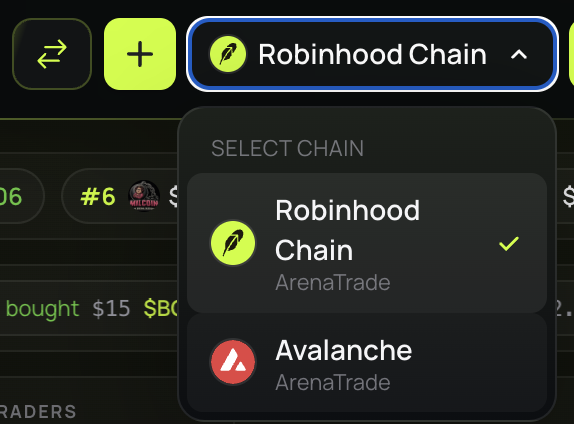
I want to buy AVXTO at ArenaTrade but it says token not found!
ArenaTrade links now default to RobinHood chain. Click on the network selection dropdown at the top and select Avalanche
Help my balance is wrong!
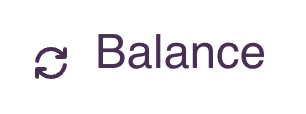
99% of the time, fixing your balance is just a matter of clicking on the reload icon next to Balance:
Now for the longer story. AVXTO is not an official Ava Labs wallet. When you use AVXTO, you’re hitting the same free API endpoints used by the official Core App. Thus, we must be extra polite netizens to be able to continuously use these API endpoints and not break stuff.
For this reason, AVXTO comes with several rate limits and precautions to not hammer the public Ava Labs API endpoints. And many times, these limits cause timeouts. When a timeout is reached,your UTXOs may not have fully loaded and you get incomplete balances. Your Core Extension should still show your balances correctly, because Core has no API usage limits (they own the thing!)
I’m getting “Error – UTXOSet.getMinimumSpendable: insufficient funds to create the transaction”
Same solution as in the previous question. Reload the balance to refresh your x or p-chain UTXO set.
How do I know AVXTO Wallet isn’t snooping on me?
(Posted by @REKTBuildr on social media)
There’s several possible attack vectors here. Some I can think of right now : the developer (me), the dependencies and the hosting.
About the “me” part : the whole project is open source. You can view everything I do here https://github.com/avaxto/avxtowallet If I were to inject something malicious I’d end my life as a developer, my family would disgrace me and I’d probably get jail time. So that’s the “me” part.
Then there’s the Typescript and Javascript dependencies. Those are a risk factor on every web-based wallet. Every single browser extension like Metamask and Core App use the same stuff. I used the same stuff Core App does. I added security measures to the javascript workflow that are compatible with what the other wallets are currently doing. Lastly, there’s the web hosting for the wallet – this is critical. E.g. if the intern at the hosting company altered the wallet code, he could attack users. I then studied the most popular web-based wallets to find out how they get hosted in a way that files can’t be tampered with. I found out they host using git.
Git tracks all modifications, so if any files were tampered with, we’d see it there. So here’s how it works : the code at https://github.com/avaxto/avxtowallet gets compiled(built). Every build automatically gets a unique number (a git “tag”). This build and exact same number are committed to another Git repo here https://github.com/avaxto/wallet – this is the actual thing that you see at http://wallet.avax.to which is just a Git “pages” website that loads the files in the latest commit.
The wallet is served straight from here https://github.com/avaxto/wallet – so if any files are tampered with, you would see the changes on github AND they would not match the version number here https://github.com/avaxto/avxtowallet
The latest tag number on the source code must match the tag number on the built site which must match the number on the user interface.
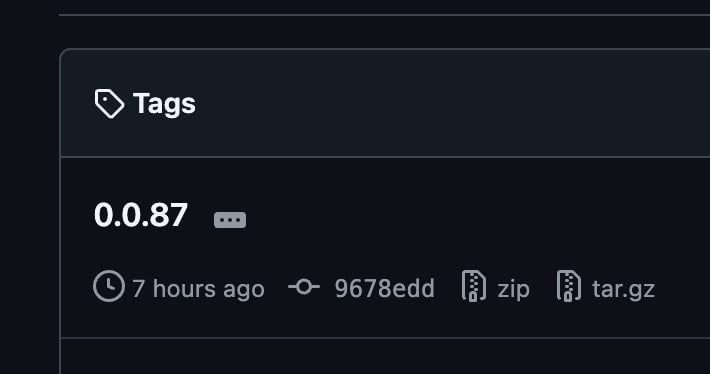
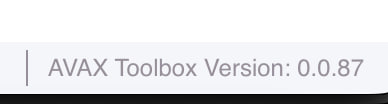
That way all 3 pieces are tethered to each other in a setup I assume is impossible to tamper with.
I have deposited the minimum AVXTO amount and still see the insufficient funds page!
First of all, check your c-chain token balance on Avascan, Snowtrace or Avalanche Explorer. You should see the correct AVXTO balance there. If you don’t, then you’ll need to fund your account with a minimum AVXTO amount indicated by the wallet system.
AVXTO Wallet loads your AVAX and token balances from web services. Sometimes the web service may fail or take too long, triggering the wallet check before the balance was loaded.
99% of the time it’s a matter of retrying and everything should be fine. Go back to the start page and retry accessing the wallet, it should work now.
AVXTO is too slow how can I fix this?
As we just mentioned, AVXTO is an unofficial Avalanche wallet. Thus we must be conservative in our free Ava Labs API endpoint usage. For this reason, in the settings page, you will find the rate limiting config. This is a fixed window rate limiter, meaning you set a window size and interval. If more requests are made than the window size, they are queued until they can get serviced inside that window. Requests are only sent after the interval. Thus, using these 2 parameters you can configure how fast AVXTO sends out network requests.
To speed AVXTO up, you may decrease the time delay and increase the window size to whatever values you wish. Just keep in mind if you hit “HTTP 429 too many requests” errors, it may take hours to reset your public API usage. And if you go over the edge, your IP may get permanently banned.
Help I got 429 too many requests error!
If you get HTTP 429 errors, AVXTO must be closed immediately. It means the public API endpoints have been overwhelmed by your usage.
Close AVXTO, wait at least 30 minutes, then when you reopen the app, go to File -> Settings and decrease the max requests per window parameter. You may also wish to increase the window size, with fewer requests per window. Eventually you’ll find a combination that does not trip 429 errors. Take note of these values as they’re likely the limit of your public IP’s maximum quota of API usage.
Are there optimal values of max requests and window size?
Unfortunately, no. It depends on many factors, all of which are out of the AVXTO developers’ control.
For example, an old wallet with very many X-chain addresses will make proportionately more API requests than a wallet with just one single address.
Also, your shared ISP address block may have several people using AVXTO, limiting how much quota each IP address is allocated.
The number of tokens and your overall portfolio complexity also determines how much network usage you need. Querying balances and prices for all these tokens requires lots of network activity.
Sometimes, owning several separate smaller wallets is better than just one huge wallet. AVXTO makes it easy to access wallets due to its stateless nature.
What is the session password being requested for my mnemonic wallet?
The session password can be anything you want. A dot, a random word, a PIN, anything, even nothing. It is never saved anywhere and is only used for the duration of your AVXTO session.
The purpose of this password is to encrypt all the secrets derived from your mnemonic phrase while you use the wallet. If anything happens, an extension gains access to your browser contents, a javascript debugger tries to read secrets or anything like that, they won’t be able to access your private keys, seeds and other secrets because only you know the session password and it’s never stored anywhere in the AVXTO Wallet source code.
This feature is provided for abundance of caution. It’s very unlikely someone would be able to dump these secrets from the browser memory, but with crypto you can never be too safe. Most wallets don’t feature anything like it, it’s an exclusive AVXTO Wallet feature.
You can leave the session password blank if you wish. There is no minimum password complexity enforcement, since this is an extra feature provided for your own protection. If you leave it blank, the secrets will still be encrypted in memory but a hacker would easily guess the blank session password and then be able to recover your sensitive data.
How do AVXTO Wallet versions work?
AVXTO Wallet uses the traditional open source versioning scheme made up of 3 numbers joined by dots like so MAJOR.MINOR.PATCH. We’ve set the maximum for minor and patch to 99, so there’s no 100 version for those. The MAJOR part is unlimited.
Every time we deploy to wallet.avax.to the patch version is increased by 1 to differentiate it from the previous deployed version. That way, every deployment is a checkpoint that is verifiable in case anything breaks. Minor version is then increased by 1 whenever patch reaches 100. Patch is then reset to 00.
It’s important that the current source code tag, the built wallet tag and user interface version all match. See “How do I know AVXTO Wallet isn’t snooping on me?” question for more details about this.
What can I do with the Broadcast TX feature?
When you send coins or tokens over the Avalanche network, what you’re actually doing behind the scenes is 2 separate steps. First you’re building and signing a transaction data structure using the Avalanche protocol format. Second, you’re sending that transaction to peer nodes so the TX can propagate through the Avalanche P2P network.
AVXTO Wallet allows you do perform these steps separately. You can build and sign the transaction now, copy the Base64 TX to notepad or send it over to someone via whatsapp or Telegram, then that other person can broadcast it over the network using AVXTO Wallet’s Broadcast TX feature.
It’s safe to send the signed TX over insecure channels. It’s public information, after all, most of the signed TX data will end up in the blockchain for everyone to see!
There are many advanced use cases for this feature.
For instance you may not trust a certain network, so you can unplug your computer from the network, sign the TX, copy the base64 code and save it somewhere for later. You can then access AVXTO Wallet from somewhere else and broadcast the TX from there.
You can also build and sign a TX that you don’t wish to send now. Save it somewhere or send it to a friend who can broadcast it later.
What is AVXTO’s stateless nature?
AVXTO is a stateless wallet. Meaning it does not store data from one session to the next. As soon as you log out of AVXTO, it forgets everything about you. This is different from Core App which uses a login and password to remember your contacts, accounts and so on.
AVXTO stores nothing about you. Your “login and password” is your crypto private key.
As you can see the AVXTO workflow is different from Core App. You give AVXTO some form of signing capability, either through an external signer like Ledger or Core App, or by entering a mnemonic phrase, use all the wallet features you need, then close it. And that’s it.
As soon as you close the window or exit the app, all the ephemeral data that was contained in your computer memory is gone, keys, addresses, everything.
In the AVXTO paradigm, they only permanent data is on-chain. Your private key is your proof of identity. When you log in again using your on-chain “credentials”, AVXTO loads your info from the public blockchain, not from your local computer.
If you access AVXTO from 10 different computers, you should get the same result on all 10 of them. You don’t have to have something like Core App installed on each one. Unless you want to, of course, AVXTO works perfectly with Core.
Explain the AVXTO tokenomics?
AVXTO was launched via the Arena. It was initially only traded in ArenaTrade, although now it’s also available in other DEX’es (hopefully more will add AVXTO as we make progress).
As an Arena launched project, its tokenomics are the same as every other ArenaApp platform project, 10B capped max supply with around 32% spread in DEX liquidity pools
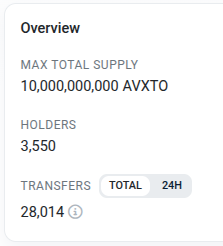
Who controls the AVXTO contract?
We, the developers of AVXTO software, do not control the token contract. It is managed by Arena’s automated launchpad.
Since we launched the token, the Arena @avxto user bought 3 billion AVXTO. This is our project Treasury which we’ve pledged to keep locked forever, or until the community decides something should be done with it (cross chain to other platforms?). The 3B AVXTO under this account may be considered locked:
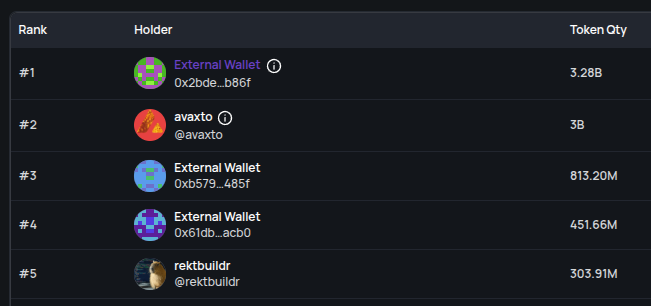
AVXTO software developer @rektbuildr is currently the #5 largest token holder at around 300M AVXTO. These tokens are not locked and may be eventually traded to pay for dev expenses.
How is AVXTO funded?
We’re self funded. @rektbuildr is an Avalanche OG and AVAX hodler since the genesis block.
The end goal is to make the AVXTO network self sustainable by using AVXTO as the value token for the entire network, present and future.
At some point, P2P network transaction fees paid in AVXTO will pay out staking rewards for network participants, akin to validation/mining. When this point is reached, AVXTO should be a self sustaining P2P network with reasonable payouts for everyone involved, including the founders.
For example, the 3B AVXTO treasury could be staked and the original devs could get paid by its rewards. We all grow together!
What are the AVXTO socials?
DEV: @rektbuildr handle under Github, Arena and Telegram